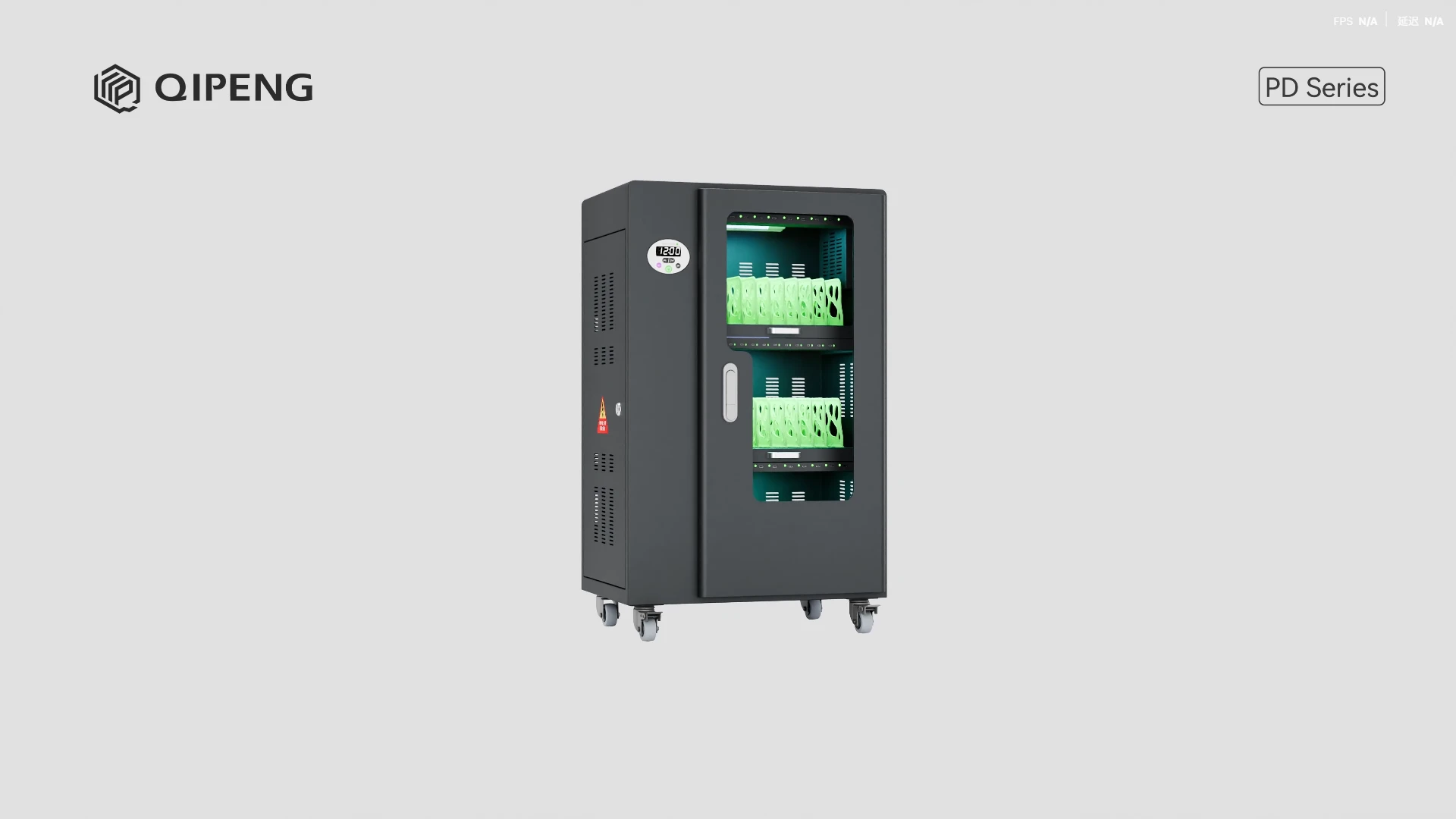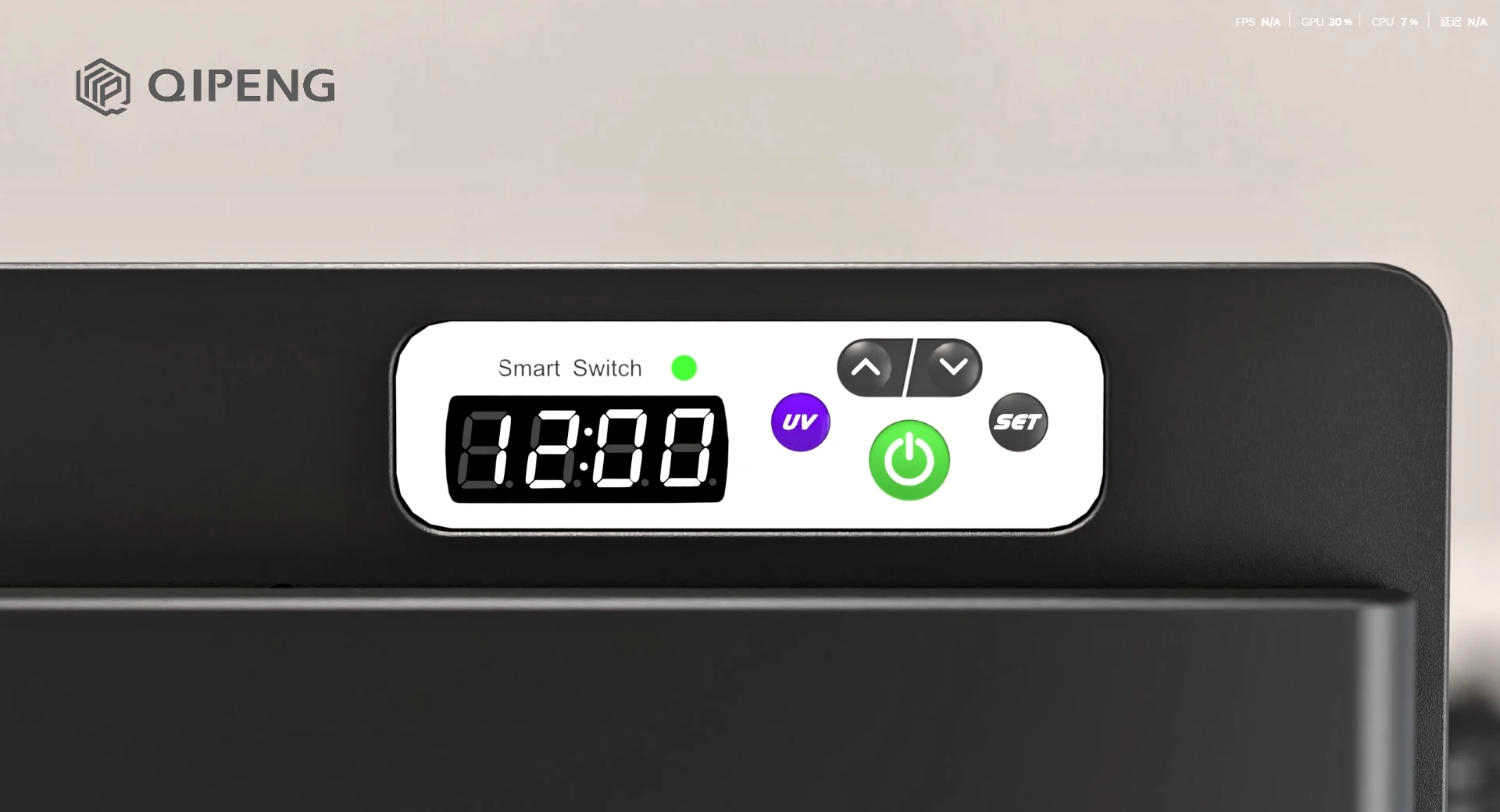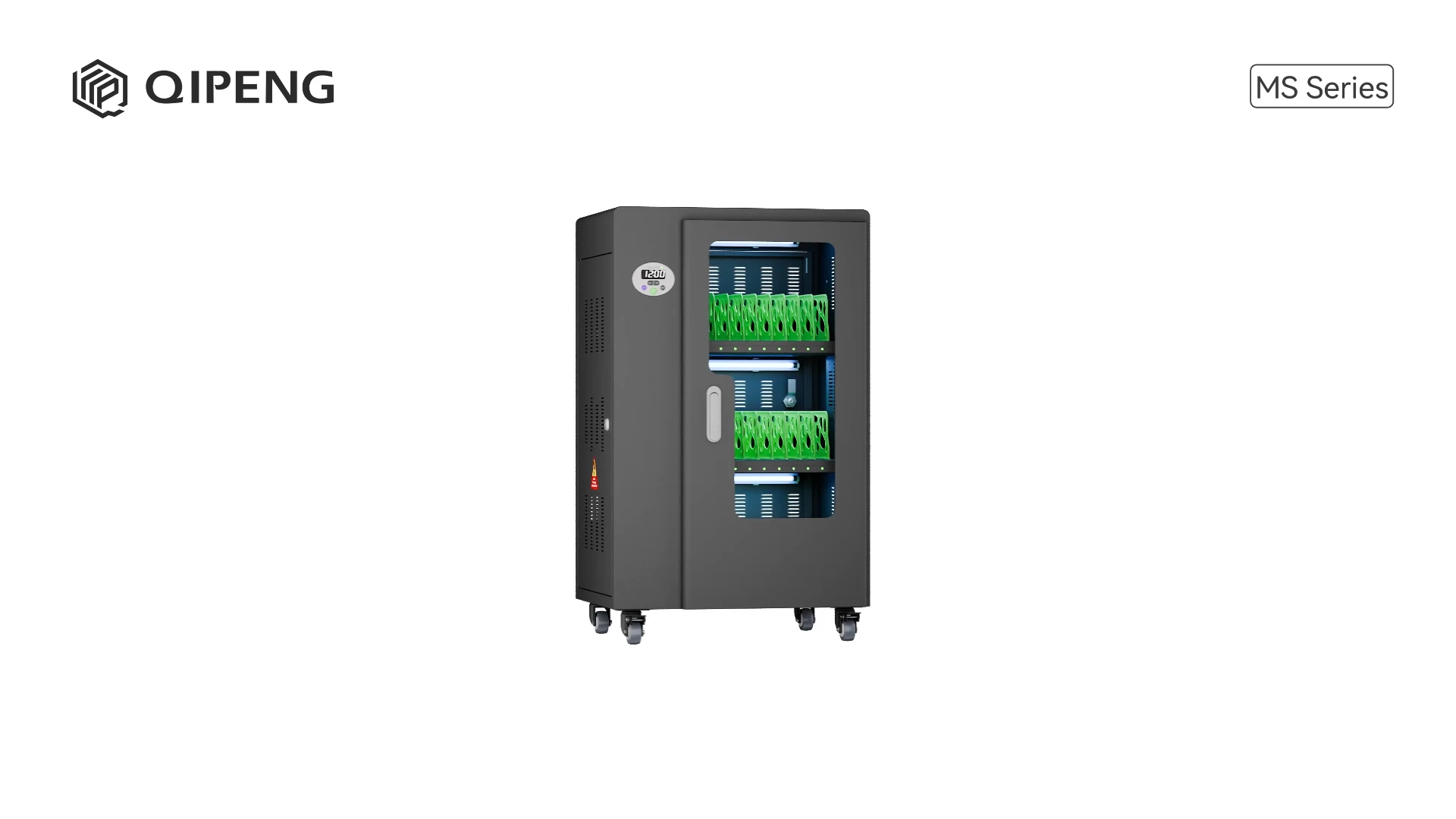
Short answer: A charging cabinet for healthcare keeps shared tablets and laptops charged, organized and locked away between shifts, and models with built-in UV-C add an extra hygiene step between users. Qipeng added UV-C disinfection to its cabinets in 2020 to address public health and safety needs. It does not replace cleaning or your facility’s infection-control procedures.
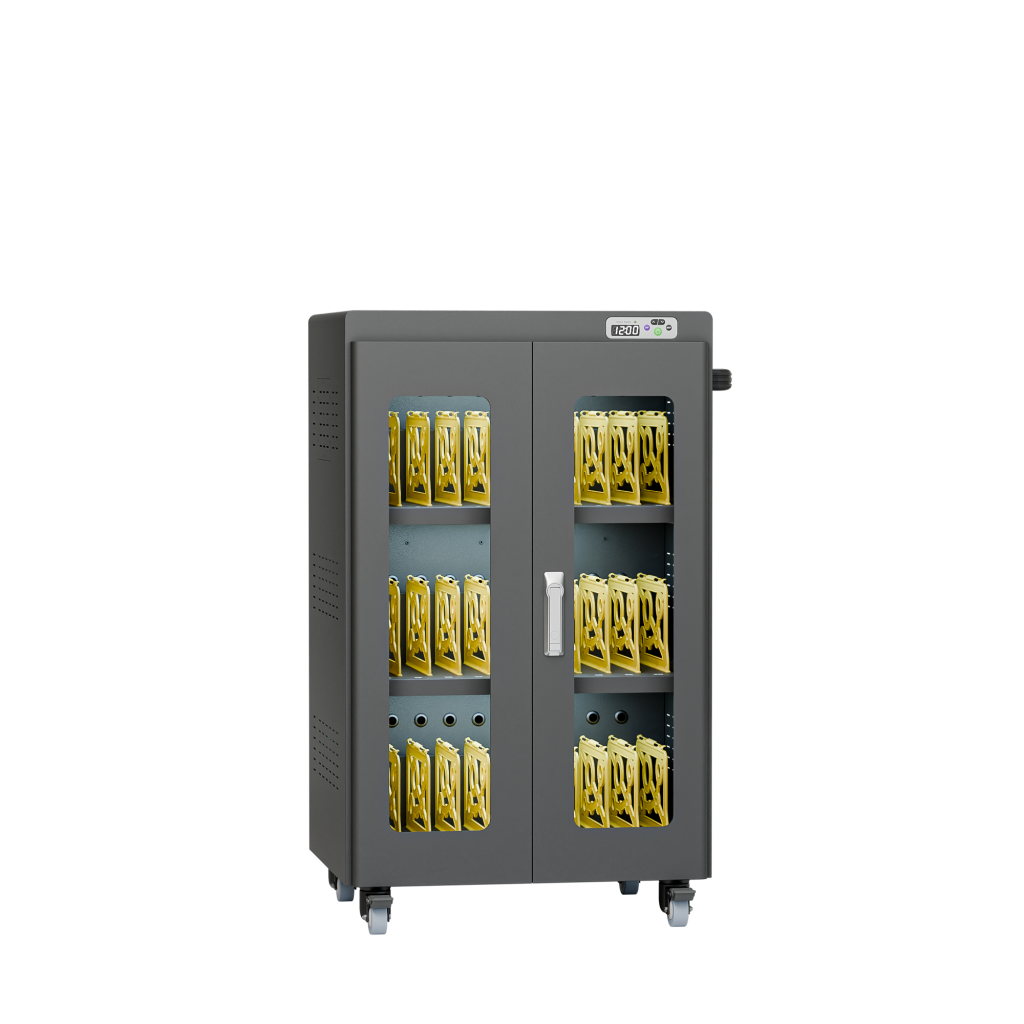
Why use a charging cabinet in a healthcare setting?
Hospitals and clinics use many shared devices: tablets at the bedside, laptops at nursing stations and mobile devices for staff. These devices change hands often, need to be ready at the start of every shift, and often hold sensitive information. A cabinet gives them a fixed, lockable home with safe charging.
The main benefits
1. Devices ready at every shift change
All ports charge at the same time on independent circuits. Timed charging with automatic power-off helps protect batteries over repeated daily cycles.
2. An extra hygiene step for shared devices
Qipeng’s TC series is described for shared equipment in high-traffic environments such as schools and hospitals, and the SYNC series offers a one-key 5-minute UV-C cycle. On the PD and SYNC series, the lamp turns off when the door is opened. Read more in our guide to the UV-C charging cabinet. For background on the technique, see ultraviolet germicidal irradiation.
3. Security for devices that hold sensitive data
Cabinets have key or mechanical locks. For devices assigned to individual staff, the LC locker offers face, fingerprint, password and RFID card unlocking, with remote control from a mobile phone.
4. Batch management for IT teams
The SYNC series connects to a computer over USB, so IT staff can install software, update systems, transfer files and reset data across many devices at once.
5. Mobile, tidy and safer than loose cables
Carts with casters and push-pull handles can move between wards or departments. Internal cable management keeps chargers off the floor, and multi-layer circuit protection (overcurrent, overvoltage, grounding, overtemperature and overload) protects the devices and the cabinet.
Which cabinet fits which healthcare scenario?
| Scenario | Suggested series |
|---|---|
| Laptops at nursing stations or workstations | TC (laptops up to 14 inch, UV-C) or PD-65W |
| Shared tablets moved between wards | TB or MS |
| Tablets needing batch updates or data reset | SYNC |
| Devices assigned to individual staff | LC locker |
| Fixed charging point in limited space | SP or WH |
Important points before you buy
- UV-C is not a replacement for cleaning. It only treats surfaces the light can reach, so keep following your facility’s infection-control procedures.
- Check electrical requirements. Ask your facility engineers to confirm that the rated power, voltage and plug type meet local rules. Request the certificates for the exact model you plan to buy.
- Measure your devices with their cases against the slot size, and confirm the charging port type.
- Plan the route. A 30-bay TC cabinet weighs about 69 kg net, so check corridors and elevators.
For help with capacity and port types, see our guides on charging laptops and tablets together and choosing a charging cabinet for 30 tablets.
Frequently asked questions
Does UV-C make devices sterile?
No. Qipeng describes UV-C as helping reduce cross-contamination on shared devices. It is an extra step, not a guarantee, and it does not replace cleaning.
Is the UV light safe for staff?
On the PD and SYNC series the lamp turns off when the cabinet door is opened. Never operate the lamp with the door open.
Can I order a customized configuration?
Qipeng supports OEM/ODM. See OEM/ODM or contact us. More answers are on the FAQ page.
Planning a rollout? Tell us your devices and quantity, or browse the product shop.